Thursday, May 29, 2014

Putrajaya - Red Bull Air Race

If there is one thing which I have not done quite properly over the past few months, it would be posting. Travel and stuff got in the way, and general laziness, but 2 weeks ago, I attended something which I heard of and found quite interesting. It became all the more interesting when a round was held in Putrajaya, of all places.
Red Bull Air Race Putrajaya ticket
This was the Red Bull Air Race, Putrajaya, held over the weekend of 17 and 18 May. Tickets were fairly priced: MYR 85 for Qualifying on 17 May, MYR 129 for Finals and RM169 for both days. I opted for both days.

Day 1 was fun, albeit chaotic. There was a slight hiccup when ticket holders of Zone A were denied crossing the bridge that links Zone B and the main Race area from Zone B due to safety reasons. A no show of buses to transport those stranded while being denied the option to enter Zone B, which I believe is the same ticket category, of course created quite a number disgruntled ticket holders. In due time, we were allowed entry to Zone B, which while on that day itself sounded like a consolation, on Race Day became a Holy Grail.

Granted, weather-wise the day itself did prove to be a bit of a downer. It rained in the morning, and of course the qualifying rounds had to be postponed from the scheduled 1130 to 1330. When the time came, the rain stopped, but light intermittent drizzle though in miniscule amounts and gloomy overcast weather gave me the impression of a dampener for the day.
Flying in on low approach past the Seri Gemilang Bridge
Yet, the image of acrobatic planes doing their stuff, flying in low on approach over the ‘gates’ of the Seri Gemilang Bridge after being granted 'smoke on' to enter, then making zips and turns, steep ascents and teeth clenching dips did much to keep me stuck at my perch. Cloudy weather disregarded, but eventually Sol did shine through the cleared-up skies. It was then did I have an appreciation for the sport.
Steep climb up past the finish gate, after the first turn
Day 2 was more interesting. After learning from the mistakes of Day 1, I found out where the shuttle buses were, despite the lack of signs, and that saved me quite a penny from the fixed charge taxi trip to the site. This time, we got to Zone A proper, which though larger than Zone B, did not afford quite the same vantage point as Zone B. In fact, by now I longed to return to Zone B having had a taste of it the day before.

Finishing after two rounds towards the Finish Gate
It was far busier than Qualifying day, and had the feel of a Red Bull-infused Sunday Picnic, with options of ‘orange juice,’ soft drinks and random snacks. All that was missing were a few bottles of vodka and jaegermeister (which I shall neither confirm nor deny bringing in quietly to the grounds).

Despite not getting a full view of the course or a dramatic approach like in Zone B, Zone A did offer a full sight of the acrobatics on display, which in a way made up for it.
Steep curve viewed from Zone B
The numerous acrobatic planes zipping up and down, making interesting turns all at quite some speed was truly astounding, though what got more interesting was when a finalist in the final 4 was disqualified as ‘Did Not Finish’ for going at 201 knots, 1 knot above the approved approach speed of 200 knots.
Having had this taste of the Red Bull Air Show, safe to say I will be keeping a keen eye on this sport, especially if the aerial site is held in stunning surrounds with dramatic backdrop. Word has it the finals in China might be held in Shanghai. The location is yet to be confirmed at time of writing.
Two planes dancing above Putrajaya Lake
Plane acrobatics in Pudong/Puxi, anyone?

p.s. there is a much better write up on this by my friend Stefan Seville. Honoured to have a mention in his article.

http://www.airshowsreview.com/Red_Bull_Air_Race_Malaysia.htm

Saturday, April 26, 2014

Kuching - Climbing Mount Santubong

Mount Santubong, on the Damai Peninsula, about 30 minutes drive from downtown Kuching, is 810m above sea level. Sounds tame, but looks can be deceiving, as after a fairly gentle gradient up, it becomes a serious climb, with scaling required where the grade can reach 75*, in short almost vertical. That is why I flew in over the Easter Weekend to Kuching with my Camelbak.

Having done some prior research, apparently, it takes 3 hours to reach the summit from the Bukit Puteri Entrance, without stops or delays, and just slightly less to come down. It takes an extra hour from the Restaurant Entrance just down the road, as you will be passing the aforementioned waterfall. Both good starting points on a mountain that inspired Alfred Wallace's 'Sarawak Law' during his stay here.

Intent on doing the summit directly, DC and I chose the Bukit Puteri trail, and after paying RM8 at the entrance and parking our car by the side of the road, we started our ascent at just after 0930. The entrance is manned by the same people as the restaurant, and they will watch out for your car in addition to logging your details. Officially, this site is a National Park, and fees are collected by the Sarawak Forestry Corporation, so this subcontracting is somewhat questionable, but at time of writing has yet to be satisfactorily explained by anyone.
Ant Highway, goes on for a few metres, along summit trail
This trail is a single shot up along the ridge, with nice views of Santubong Village, the Santubong River and Kuching City on your right, with nature to your left. I was tempted to run up, the trail runner within keen to hone his skills, but DC, despite being muscular and a regular gym goer, talked me in to keeping a steady pace. I compromised with a somewhat fast steady pace, intent on reaching the summit in under 3 hours.
Mt Sejinjang, Pandak and Panjang beaches, Salak River in back;
Santubong Village and Santubong Estuary in foreground
After under an hour from the start point, we reached the split. The route to the left goes to the jungle trail, waterfalls and restaurant entrance. Upwards is the summit. After a brief stop for DC to get some air, we ploughed on ahead.

Shortly after the split, the trail became steeper, and we bumped in to our first group of hikers. After pleasantries, we pressed on ahead, to be greeted by what was the first of a few somewhat challenging ascents. At 30-50* grade, we had to really hike up, with the aid of ropes for some, or makeshift steps from soil and roots for others.
Trail map, not to scale or trail, Mt Santubong
Here, we reached the second of the pit stops, and a view point somewhat obscured by a rock. This was just under F7, at ‘Viewpoint 2.’ After a brief stop and some picture taking, we both decided to send pictures out to make some of our friends envious. I am more surprised that here, in the middle of dense jungle on a mountain, I had excellent BlackBerry coverage, even better than in some parts of KLCC.
Santubong River, Mt Sejinjang, Kuching City;
seen from Viewpoint 2, Mt Santubong
We ploughed on ahead, with more ropes to guide us along the steeper bits. The entire thing made me think of the Hash Challenge trail running marathon I did last year. As we were climbing up, we both kept yakking away to keep our mind occupied and I retold my entire 42k Hash Challenge story to DC. If I could do 42k up and down mountains in just under 11 hours, this 10k return trip should be doable. He called me a crazy mountain goat effortlessly scaling up rock face.

The steep bits done, DC hinted that if it kept getting steeper, he would turn back. I told him we were close by the summit, which was true. There, at F8, at 1,561 ft, we had a view of the city, a clear view of the summit within reach, and voices just beyond the trees. We caught up with a big group.

After a small bar of chocolate to keep us on the move, we continued on. I conveniently neglected to tell DC that there were steeper bits, wooden climbs, valleys and sheer rock face coming along.
Steep climbs, boulders and ropes; Mt Santubong
Within short order, we reached the first bit of the really steep bits, maybe 60* grade. We caught up with the group just ahead of us. After holding on to rope ladders and plank stairs, we were right behind them, and DC, sensing my agitation, told me to slow down and wait for them to clear.
Roots and trees and a deceptive incline
That I did, as DC took that opportunity to slow down slightly, catch his breath and drink some water. I told him to ration his 1 liter as much as possible. He somehow did not listen to my advice of taking 1.5 litres. After waiting for clearing, we scaled up the rope ladders along bounders and sheer face, careful with our footing and wondering how they decided on spacing the ladder handles.

At F11, we bumped in to yet another group, this time making their way down. This tested my resolve for zen, as we patiently waited for 3 big groups to clear: one before us waiting to climb, one in the middle taking pictures on the mid-rope landing and another going down from the top.
Steep walk down, Mt Santubong
While waiting, we met this lone Caucasian guy descending. He told us that we had an hour to the summit, and that there were a lot of ropes and roots to hold on to. So, after 5 minutes of agonizing wait, we went up, and taking advantage of the less steep and wider hold area, by-passed the group on the open side and went to the last ‘basecamp,’ F12. There were a few people who just sat by this summit, content with this height, with the summit-proper was just in reach.

And there, with the goal in sight and determination filling my very being, the moment DC reached the summit of F12, I gave him just enough time to catch his breath and have a sip before we did the home stretch.

Just as we went along another steep descent and ascent, we bumped in to another group. The leader informed us that we had 45 minutes to an hour to reach the top and advised us to rest and take it slow as it was basically a vertical climb. DC and I had other ideas: I wanted to reach my aim of the summit in under 3 hours and DC wanted this challenge to be over and done with.

After the steep descent and ascent which was somewhat technical for efficient climbing, at F13, we reached the most challenging park of the climb: the 75* grade. This was almost vertical, with rope ladders and roots your only foothold against solid rock. This was not a walk in a park.
Damai Peninsula, Damai Golf Club and South China Sea,
from Mt Santubong summit
Once at F14, I called out to DC, who kept going strong, and told him we were close. As I let him rest momentarily, I went up to recce the rest, and before long, I told him to hurry up. The stop at F14 was basically the slight pause before the fanfare in Handel’s Zadok the Priest.
Santubong River, Kuching City in the distance, Mt Santubong summit
Flag of Sarawak, Mt Santubong summit
'Welcome Arch,' Mt Santubong summit
Cloud cover, Mt Santubong Summit
Immediately after F14 after scaling up boulders and stuff, lay the top of the ridge, the summit, F15. The views were spectacular. The Damai Peninsula before us, the South China Sea, the Santubong River, coves and bays and beaches. There was a small inscription at one of the boulders at the top, commemorating the legend of ‘Datuk Merpati.’ A carved head lay hidden somewhere amidst the foliage.

At the top, at 810m, we explored the narrow ridge. There was a small pool, which had some water, and a thatched hut. There was even a topiary archway and of course, a flag at the top. The view above the cloud line was beautiful, with the City of Kuching laid before us.
Santubong River Estuary and cloud-line
After a few minutes of contemplation, we made our way down. Just as we did, a group of Caucasians came up. One was a blonde guy, shirtless with a heart monitor, determined as if he was racing up. A few steps behind him, another blonde guy with a girl, both looking very fit. Trailing behind them, another Caucasian girl and just a few steps behind her, a Norwegian man who called out to his wife at F13. These were serious climbers, no joking here, all complete with gear.

I admired their determination and resolve, and their almost single-mindedness to reach the summit. They, I told DC, were the proper Mountain Goats, as I was all but a Mountain Kid, still getting his rock climbing feet stable.
View on the descent: The Serapi Range in the back, middle is Pandak
and Panjang Beaches and parts of Santubong Village in foreground
At the ranger’s office, as we signed out, the park ranger was impressed at our speed, and asked if we ran up. I told him we did not, just a regular, steady but brisk-walk pace. He told me we did it faster than the most. How Alfred Wallace did it during Sir Charles Brooke's reign in the State, considering the steepness and lack of trails then, is in itself an example of the toughness of British explorers in the Victorian Age.

He even asked me if I bumped in to the Caucasian group going up and I told him they did. After explaining to him the heart monitor, he tells me they do the climb very regularly. After congratulating us on our speedy ascent, we drove a short hop to Damai Central to get some drinks. DC was truly knackered and was wondering where all my energy came from. I just shrugged as I left him in the car, checking my GPS tracker on our hike as I walked to the shops to get us drinks.

All in all, the numbers on the climb of Mount Santubong:

Ascent: 0930, summit 1205; Descent: 1215, station 1405.

2 hours and 35 minutes to ascend, including stops, delays and chatter; 1 hour 50 minutes to descend, including chatter and an errand for fellow climbers; 10 minutes on the summit and walking around.

I used Nogago Tracks, very efficient especially on the BlackBerry 10.

Wednesday, March 19, 2014

Myanmar - Yangon - Day 3 Part 2

The good thing about going to a new, relatively unknown location without any expectations is that you will be either surprised in a good way, or not so good way. Bangkok surprised me with her Christian history. Jakarta surprised me, yet not really surprised (if that makes sense), over the sad, almost neglected feel of old Batavia, and more on that in a future post.
Irrawaddy Chambers, Pansodan St, Rangoon
Rangoon surprised me as I gaped up in awe. Stories I read ranked Rangoon highly, an equal to London and other great cities of Empire at her height. Then she fell in to obscurity, with her country’s troubled past and arguably present casting a shroud over her.
Turn of the century architecture, Pansodan St, Rangoon
And it is this shroud that has protected Rangoon, in more ways than one. Walking along Merchant St, the beautiful colonial splendor of merchants and their edifices to wealth, power and influence served as a stark reminder, if not a monument to their memory.
Pansodan St towards the Strand, Rangoon
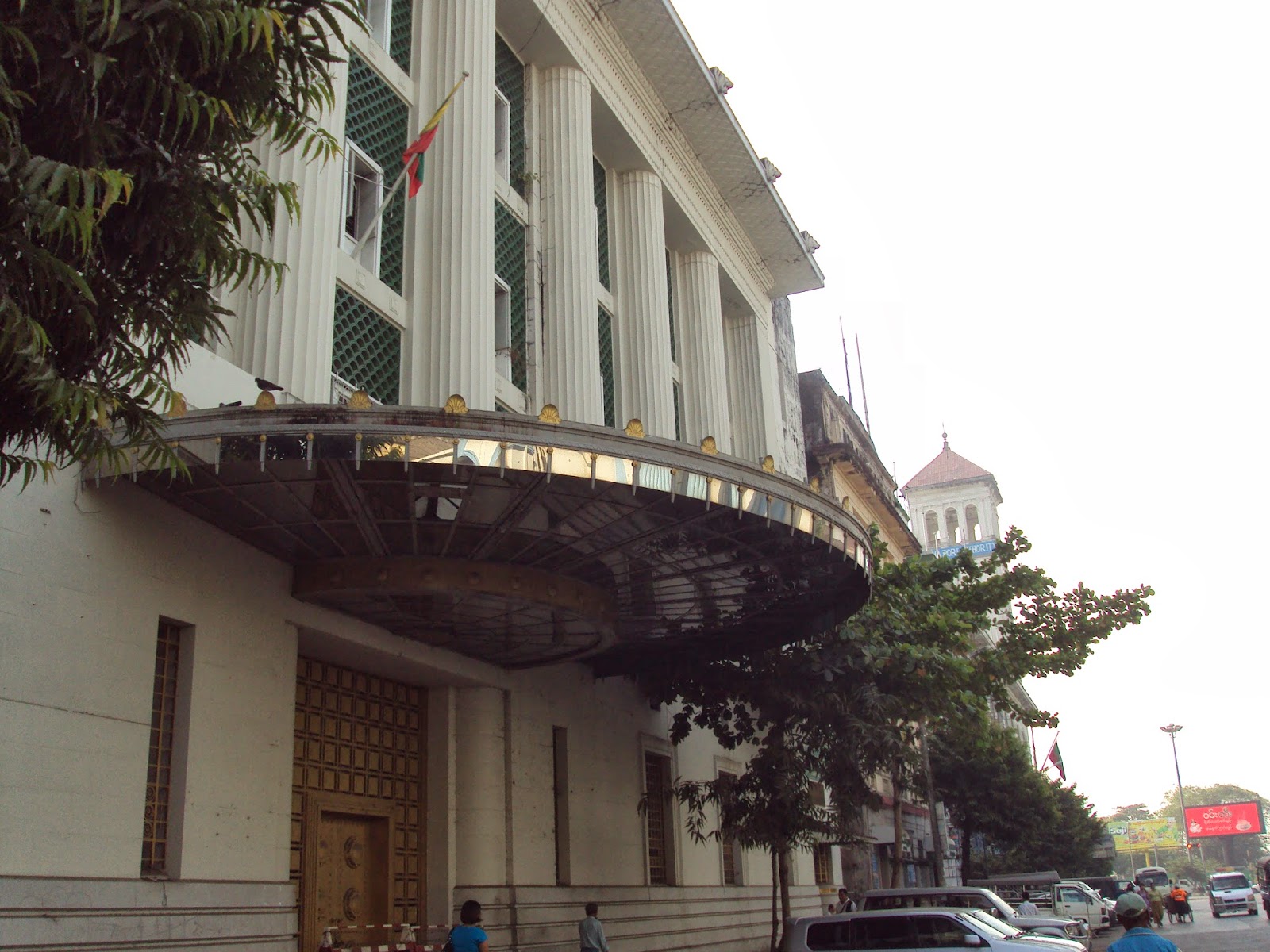
Along Pansodan Street, buildings with architecture that equal the splendor of colonial Singapore and Hong Kong stand side by side, in close proximity, almost daring the other to show who is the more powerful. Ionic, Doric and Corinthian-order columns decorate the façade, with a small show of a Dutch-inspired domed-copula building as a reminder of who else was active in the region then.
Water Transport Ministry Building, Pansodan St, Rangoon
Even Customs House has a decidedly Dominion-feel to her, and would not look out of place in New South Wales or Victoria. Her red brick and white columns provide a stark yet delightful contrast and interplay, a motive repeated from the church to the courts.
Custom House, the Strand, Rangoon
Finally, after a rather large detour, my lunch became brunch, and a slightly late one while we’re at it. I decided for breakfast at the Strand, having been informed and read that The Strand Rangoon is one of four great hotels in Southeast Asia during the colonial period built by the famous Sarkies Brothers.

Having been to their flagship E&O Hotel in Penang and Raffles Hotel in Singapore, it seemed apt for me to visit and cross another of their properties of my list. Which now leaves the Hotel Orange, now the Hotel Majapahit in Surabaya. It was only here did I have expectations, one which did not quite cut to the mark.
Main Porch, The Strand Hotel, Rangoon
The E&O and Raffles were grand, stately hotels, taking up their own city block in their own right, with an expansive ground and elegant façade. This property of the Sarkies Brothers was somewhat smaller than the others, and did not exude the same feel of elegance and opulence but instead had a tinge of understated luxury, albeit one that needed a makeover.
Reception area, The Strand Hotel, Rangoon
The interiors felt a bit small, the flooring and tiles somehow had the feel as if they were replaced rather than faithfully reproduced and maintained. Regardless, it was a nice hotel, and their croissants were very good.
The Strand Cafe, The Strand Hotel, Rangoon
With breakfast in hand, I decided to further my walk, map in hand, to find the old Minister’s Office and St Mary’s Cathedral. Walking down from The Strand along the Strand, next door was the Australian Embassy, in a beautifully appointed townhouse, with the British Embassy in the next block along the Strand.
Australian Embassy, Rangoon
Making a turn along Bo Aung Kyaw St, I found the great albeit very forlorn Minister’s Office, located at the junction of Bo Aung Kyaw and Bogalay Zay St. This great building, built by the British, almost in the style of grand New Delhi, was to be the headquarters of the Government of British Burma, and they built it well to signify their majesty and imperiousness.
Minster's Office, Rangoon, Main Facade
Minister's Office, Rangoon
It somehow felt like its own commentary, when now this monument to imperial power is now abandoned, with the building boarded up, windows missing and unkept surrounds. The building was meant to be a museum, and some work was seen when I visited, but it still felt like a very sad commentary on shifts in power.
Main Building, St Paul's School, Rangoon
St Paul's School, with St Mary's Cathedral's spires
At the northern edge of the Minister’s Office compound, along Anawratha Rd is the St Paul’s School building, a rather impressive looking school block with Elizabethan accents yet shares a similar colour scheme to St John’s Institution in Kuala Lumpur. The white spires of the cathedral poked up in the skyline, but I felt like doing a circuit around what I suspected is the Roman Catholic compound to see what else lies around it.
Building, Thein Phyu Rd
Taking a left at the junction of Thein Phyu and Anawratha Rd, I chanced upon a beautiful red bricked with white accents building, and within the Roman Catholic compound, the Archbishop’s Residence. It was here did the surprises really start.
Archbishop's House, Rangoon
It is called the venerable Archbishop’s House, but should rather be named Archbishop’s Palace. The high walls did little to hide the three storey edifice, a beautiful Italianate structure with a very practical high roof perfect for the tropics. The leafy gardens and beautiful grounds only heighten the sense of arrival to the cathedral, as the spires and towers gleam overhead.
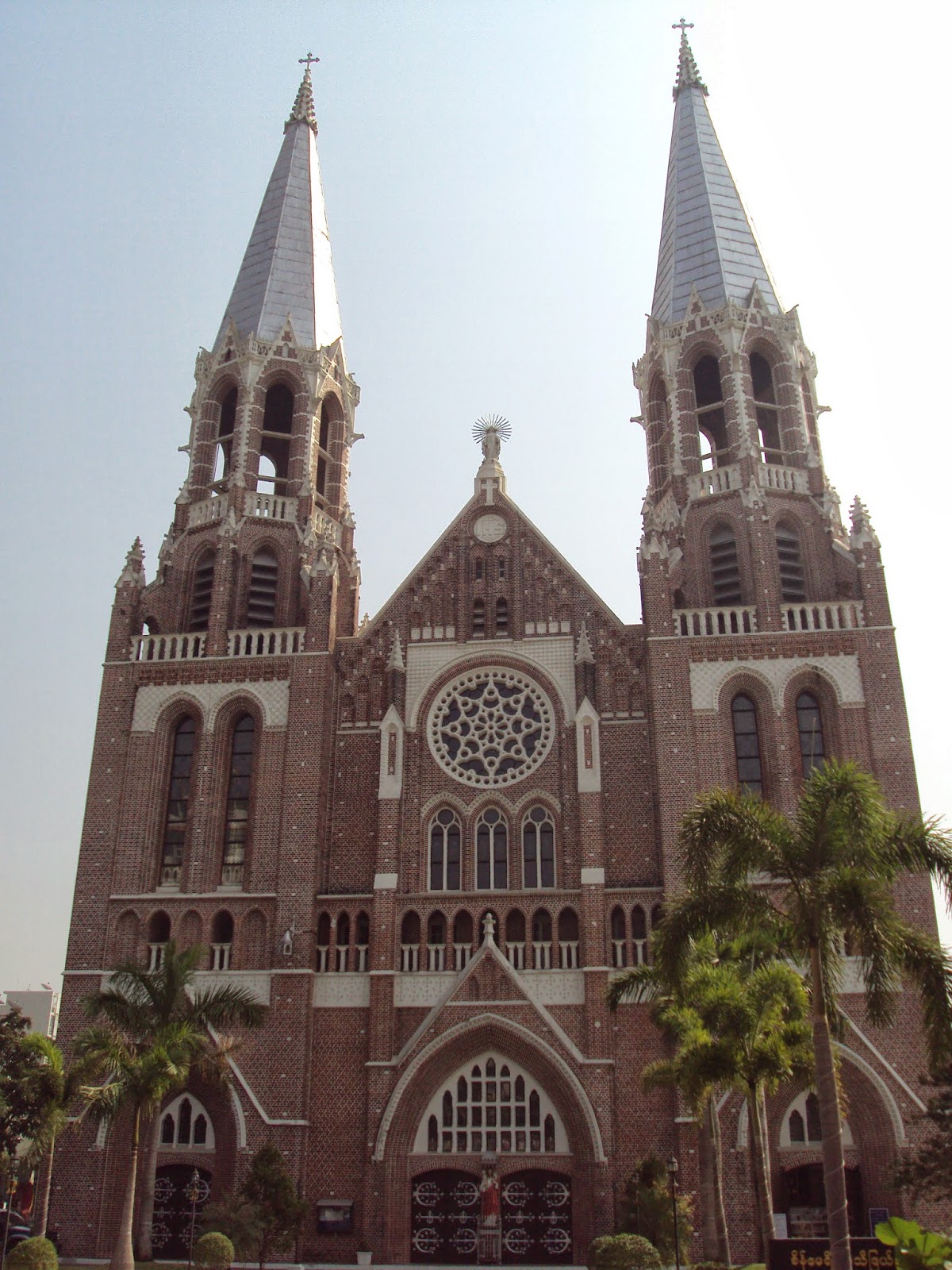
St Mary's Cathedral, Rangoon
And there it was, in all her glory. It was an impressive church building. The French did their best in Saigon, with my personal favourite being St Philip the Apostle Church with her pastel colours and French-Gothic spire and architecture. The Spanish went with ‘frequency’ of churches as opposed to British ‘consolidation.’ The Dutch went with the familiar. In this instance, the British, or more specifically the Roman Catholics, perhaps to outdo the Anglicans down the road on the other side of town with their edifice, went with ‘shock and awe.’
St Mary's Cathedral, Rangoon
Shocked and awed I was. And disappointed I became when the gate was closed and wouldn’t budge. There I was, the crux of my travels, of my venture to seek out the ecclesiastical heritage of Southeast Asia, and I was stopped by a gate that would not budge.

I said out a small prayer, requesting, if only, to visit this monument built to the glory of God. Just as I thought all hope was lost, out of the blue, someone appeared from within the church and opened the gate. There he was, a simple parishioner, but to me, he was literally the answer to my prayer. Providence works in mysterious ways.
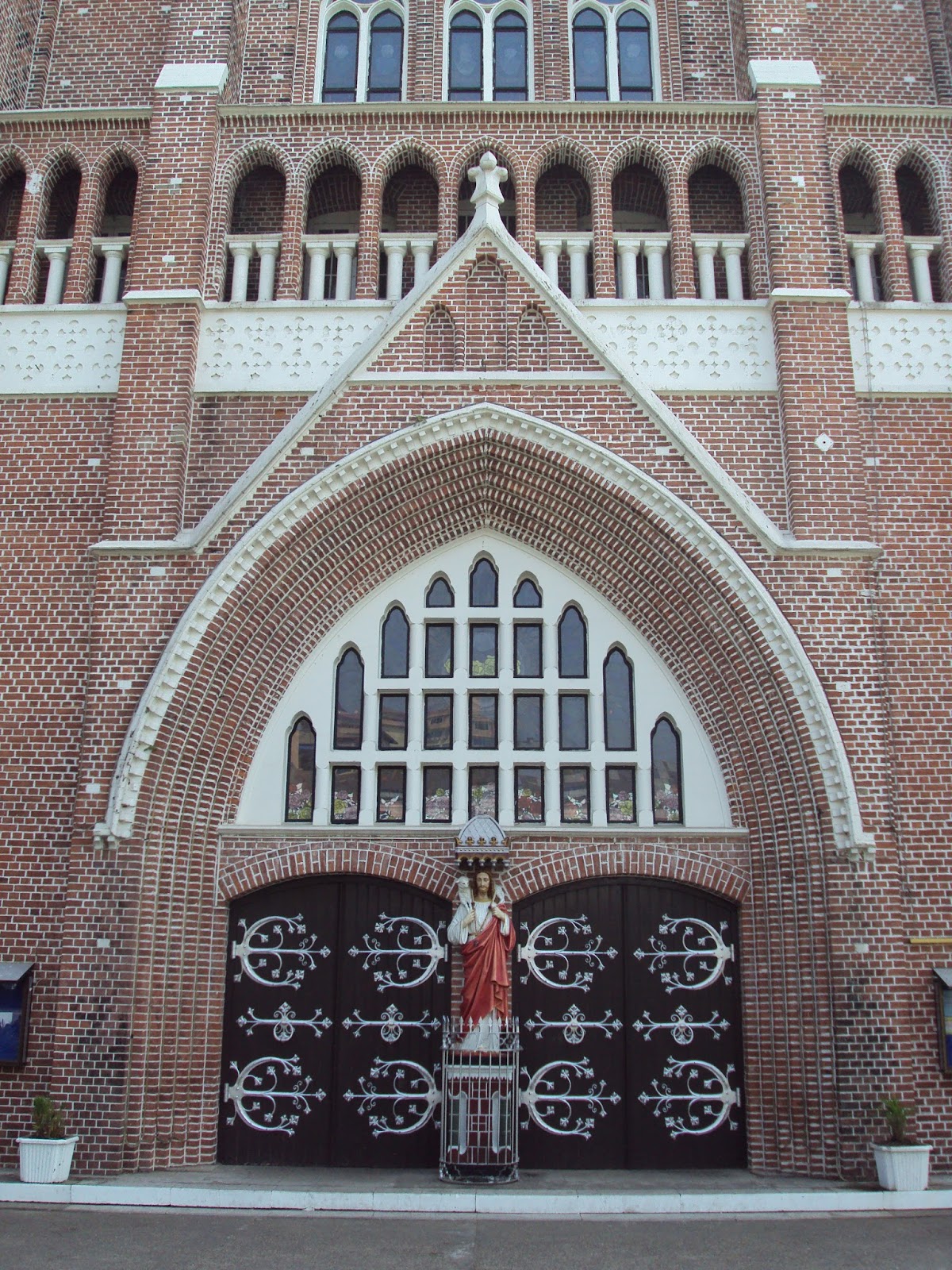
Great Door, St Mary's Cathedral, Rangoon
If the architecture outside did not awe, then the interior would surely put you to heel. From the outside, the sheer detail and scale kept with French Gothic lines; grand yet not imposing. The interior though, caused you to soar.

Facing apse, St Mary's Cathedral, Rangoon
Unlike other cathedrals of this order, there was no dark stone. Here was a riot of colour, with the red and white motif seen almost everywhere else in Rangoon present and prominent here. The vaulted ceiling highlighted by the interplay of dark against light, the stained glass windows adding further dimensions and the numerous stations of the cross and relief of the lives of the saints were not only carved in marble, they were coloured.
Stained Glass, St Mary's Cathedral, Rangoon
Niches were filled with statuary, complementing the lower panel with the carved ‘scenes’ and stained glass window in between. This was not a drab, somber church building: this was a celebration of colour, architecture and art.
Niches, St Mary's Cathedral, Rangoon
This was and is a fitting end to my journey, both of my first exploration of Burma and Rangoon, but also a fitting end to my personal project, a quest to seek out the great church buildings of the colonial age.

But there was one thing I somehow had to do. I had to see The Lady.

So, on my last day, heading to the airport, I asked my driver if we could pass her house. He was more than happy to oblige. Revealing his hopes and dreams shared with The Lady, we arrived at her house along University Avenue, along the shores of Inya Lake.

Next door, the American Embassy grounds were massive, apparently the largest in Southeast Asia. Daw Aung San Suu Kyi’s house was surrounded by a high brick wall with barbed wire, but unguarded except for a guard house by the main gate.
Party Banner, Aung San Suu Kyi's House
Sadly, I could not have afternoon tea with her: she spends weekdays in Naypyitaw and weekends in Yangon. Just as I was taking pictures and soaking in the atmosphere amidst rush hour traffic along a major road, another taxi with a middle aged couple stopped, and they also took pictures.
Main Gate, Aung San Suu Kyi's House
We acknowledged one another and expressed disappointment that The Lady was not around. Then as we took pictures, the guy commented, and I wholeheartedly agree: “We just have to do it!”

Saturday, March 15, 2014

Myanmar - Yangon - Day 3 Part 1

After the heady grandeur and forlorn glory of the Pagan Plains, I somehow savored the return back to Yangon. The dust tracks and dry surrounds gave way to uncertain driving systems within a city grid that somehow made sense. I sought to explore again.

So early in the morning, I decided to take a stroll around the city, making a loop along the grid and seeing what edifices the British left in this their great commercial centre, which apparently at its peak, rivaled London in civil services and utilities.
Former Rangoon Railway Building
Boxing the grid is the famed circular railway of Rangoon, which formed the boundary of the city core, and right next to the Trader’s Hotel is the former Railway Office, a beautiful red brick building in an otherwise unkept compound.
Restoration of Rangoon Railway Building, future Peninsula Yangon
I was informed by SSM that this building is meant to be turned in to the Peninsula Hotel Yangon, and indeed, a lot of work was being done, but still much more was needed, especially with the grounds. Even in its current state, one can already see the grandeur, and it does not take much to imagine it in its reincarnation as a luxury hotel.

Truth be told, one of my main aims in this is to finish my private project: a compendium of ecclesiastical structures in Southeast Asia. Rangoon, in its glory, somehow eluded me, until curiosity beckoned me in like a maneki neko. I have never seen Burma as a major centre of colonial power until this trip.
Scott Market, a.k.a. Bogyoke Market, Rangoon
Surely, ‘Lord Mountbattern of Burma,’ a title in itself should have hinted at its importance, yet it still did not register, and that was a thought that ran through my head as I walked westwards away from the old Railway Offices towards Scott Market, until a spire jutted out from amidst the relatively flat city scape.
Cathedral of the Holy Trinity, Rangoon
Then there before me: the Anglican Cathedral of the Holy Trinity. I did not know what to expect, but I was sufficiently blown away. The commercial and administrative centres of Hong Kong, Singapore and Kuala Lumpur may hold sway over our (or at least my) idea of British colonial splendor but little is known about Rangoon. This was like finding a clear cut diamond amongst the ecclesiastical sapphires of the Anglican Communion in East Asia.
Buttresses, Holy Trinity Cathedral, Rangoon
Rose Window exterior, Holy Trinity Cathedral, Rangoon
The red brick juxtaposed against the leafy surrounds and well-manicured lawns, the soaring white English-gothic spire balanced against the sturdy buttresses of the French-gothic support structures, the beautiful rose window against the pointed windows and gabled roofs; all within a small compound of quaint provincial life, amidst a family of ducks waddling in the green as the deacon takes a nap on a hammock underneath a tree.
Pastoral scene, Holy Trinity Cathedral, Rangoon
If the exterior was this grand, I started to imagine what the interior was like. Entering from a side door by the ambulatory, I saw a small welcome sign, and passed the small, unassuming door. I was not prepared for what surprises lay within.
Rose Window, Holy Trinity Cathedral
Apse, Holy Trinity Cathedral
Inside, despite the construction and restoration work, was a mass of space, a riotous play of light and dark punctured by the brilliant colours of the stained glass windows by the apse. Bamboo scaffolding unable to hide the majesty of the sanctuary, painting and restoration work notwithstanding, it was still a sight to behold. The beautiful rose window playing colours against the austere white of the walls, the interplay of architecture with stagecraft is almost unparalleled in the region, even when compared to other more high profile British commercial centres in the region.
Side chapel plaques, Holy Trinity Cathedral
Memorial plaques, Holy Trinity Cathedral
Within, small chapels had dedications to the fallen, as in other Anglican churches in the colonies and protectorates. The colours, standards and insignias of different regiments from different times, all form a testament and memorials to all for all.
Scaffolding statement, corner Bo Gyoke & Shwedagon Pagoda Rds
Merchant Rd, Rangoon
With my appetite whetted with this small gem, I decided to plough through the day, deciding to delay my breakfast plans until I have at least seen as much as I could of Colonial Rangoon and her edifices. Amidst the history, sections of the city were being upended and transformed, scaffolding advertise different developers doing different projects constructed by an almost multinational yet distinctively Asian face.
Old against new, Merchant Rd, Rangoon
Yet the grand colonnades and various Greek-order columns stand firm in Rangoon, despite modern Yangon trying to stamp in her authority. Some forlorn and abandoned, with dust, grime and ‘occupation’ a world away from their origins, next to gleaming yet faceless glass and steel erections that so characterize ‘development’ in Asia.
Merchant Rd, Rangoon
Buildings from all ages and times stand side by side in Rangoon and Yangon; the great British structures with their imperial defiance next to playful turn of the century Art Deco blocks, punctured by 60s Internationalism.
Corner, near Sule Pagoda and Merchant Rds, Rangoon
Yet some structures still remind you that this was a British colony close to the heart of the British Raj. Not quite part of the British Raj yet not quite part of British Southeast Asia; Rangoon shares an eclectic mix of Georgian- and Paladian-colonnades that typifies colonial Singapore and Hong Kong yet with the Moorish tendencies that highlight Kuala Lumpur and Calcutta.
High Court Building, Maha Bandoola Park St, Rangoon
The High Court Building, fronting the Maha Bandoola Garden would not look out of place in any station of the British Empire. It looks like it could belong in Melbourne, New Delhi or London itself, with its grand and almost imperious gaze down in the city. The grand clock tower in itself forms a perfect centerpiece in this monumental centre, with smaller yet equally impressive buildings paying homage, from the frosted cake of the Yangon City Hall building to a delightful building with a tower in the corner just next door.
Yangon City Hall, Maha Bandoola Garden
Northeast Corner, Maha Bandoola Garden
The more I walk, the more I became excited, wondering what other surprises lay just around the corner. The good thing about the old colonial heart of Rangoon, against the sheer mass of Yangon, is the ease of navigation within the city grid, with easily navigable city blocks.
Rander House, Pansodan St, Rangoon
With surprises at Rander House and Corinthian columns in front of it, Rangoon felt like the culmination of years of travel in disparate yet connected colonial centres in Southeast Asia, with bits of Georgetown, Victoria, Singapore and Kuching all contained within.
Corinthian columns, Pansodan St
At this rate, my breakfast plans at The Strand would have to wait a bit longer than expected. I am, after all, easily distracted when something catches my eye and my feet urge on my curiosity.