Wednesday, March 19, 2014

Myanmar - Yangon - Day 3 Part 2

The good thing about going to a new, relatively unknown location without any expectations is that you will be either surprised in a good way, or not so good way. Bangkok surprised me with her Christian history. Jakarta surprised me, yet not really surprised (if that makes sense), over the sad, almost neglected feel of old Batavia, and more on that in a future post.
Irrawaddy Chambers, Pansodan St, Rangoon
Rangoon surprised me as I gaped up in awe. Stories I read ranked Rangoon highly, an equal to London and other great cities of Empire at her height. Then she fell in to obscurity, with her country’s troubled past and arguably present casting a shroud over her.
Turn of the century architecture, Pansodan St, Rangoon
And it is this shroud that has protected Rangoon, in more ways than one. Walking along Merchant St, the beautiful colonial splendor of merchants and their edifices to wealth, power and influence served as a stark reminder, if not a monument to their memory.
Pansodan St towards the Strand, Rangoon
Along Pansodan Street, buildings with architecture that equal the splendor of colonial Singapore and Hong Kong stand side by side, in close proximity, almost daring the other to show who is the more powerful. Ionic, Doric and Corinthian-order columns decorate the façade, with a small show of a Dutch-inspired domed-copula building as a reminder of who else was active in the region then.
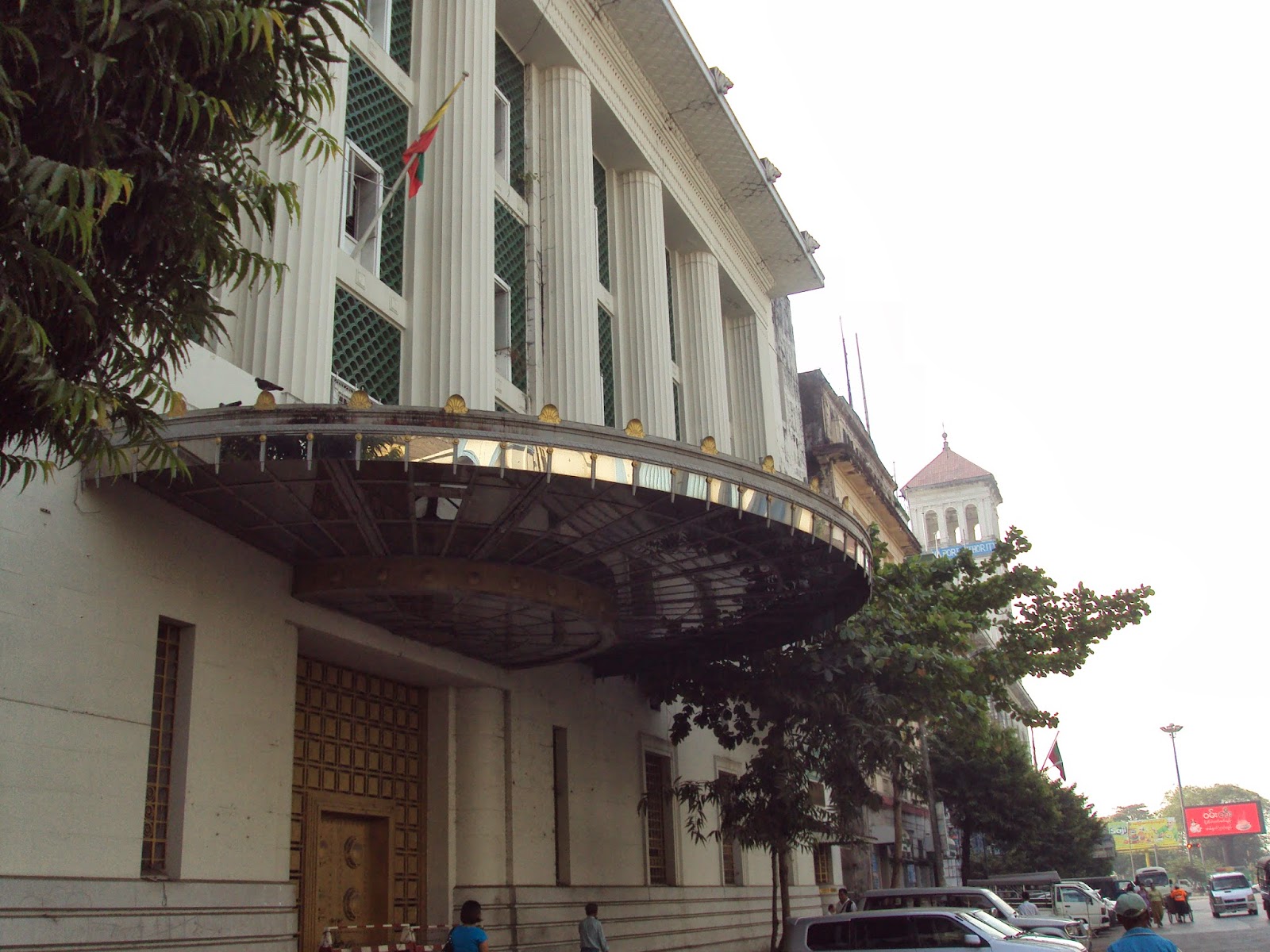
Water Transport Ministry Building, Pansodan St, Rangoon
Even Customs House has a decidedly Dominion-feel to her, and would not look out of place in New South Wales or Victoria. Her red brick and white columns provide a stark yet delightful contrast and interplay, a motive repeated from the church to the courts.
Custom House, the Strand, Rangoon
Finally, after a rather large detour, my lunch became brunch, and a slightly late one while we’re at it. I decided for breakfast at the Strand, having been informed and read that The Strand Rangoon is one of four great hotels in Southeast Asia during the colonial period built by the famous Sarkies Brothers.

Having been to their flagship E&O Hotel in Penang and Raffles Hotel in Singapore, it seemed apt for me to visit and cross another of their properties of my list. Which now leaves the Hotel Orange, now the Hotel Majapahit in Surabaya. It was only here did I have expectations, one which did not quite cut to the mark.
Main Porch, The Strand Hotel, Rangoon
The E&O and Raffles were grand, stately hotels, taking up their own city block in their own right, with an expansive ground and elegant façade. This property of the Sarkies Brothers was somewhat smaller than the others, and did not exude the same feel of elegance and opulence but instead had a tinge of understated luxury, albeit one that needed a makeover.
Reception area, The Strand Hotel, Rangoon
The interiors felt a bit small, the flooring and tiles somehow had the feel as if they were replaced rather than faithfully reproduced and maintained. Regardless, it was a nice hotel, and their croissants were very good.
The Strand Cafe, The Strand Hotel, Rangoon
With breakfast in hand, I decided to further my walk, map in hand, to find the old Minister’s Office and St Mary’s Cathedral. Walking down from The Strand along the Strand, next door was the Australian Embassy, in a beautifully appointed townhouse, with the British Embassy in the next block along the Strand.
Australian Embassy, Rangoon
Making a turn along Bo Aung Kyaw St, I found the great albeit very forlorn Minister’s Office, located at the junction of Bo Aung Kyaw and Bogalay Zay St. This great building, built by the British, almost in the style of grand New Delhi, was to be the headquarters of the Government of British Burma, and they built it well to signify their majesty and imperiousness.
Minster's Office, Rangoon, Main Facade
Minister's Office, Rangoon
It somehow felt like its own commentary, when now this monument to imperial power is now abandoned, with the building boarded up, windows missing and unkept surrounds. The building was meant to be a museum, and some work was seen when I visited, but it still felt like a very sad commentary on shifts in power.
Main Building, St Paul's School, Rangoon
St Paul's School, with St Mary's Cathedral's spires
At the northern edge of the Minister’s Office compound, along Anawratha Rd is the St Paul’s School building, a rather impressive looking school block with Elizabethan accents yet shares a similar colour scheme to St John’s Institution in Kuala Lumpur. The white spires of the cathedral poked up in the skyline, but I felt like doing a circuit around what I suspected is the Roman Catholic compound to see what else lies around it.
Building, Thein Phyu Rd
Taking a left at the junction of Thein Phyu and Anawratha Rd, I chanced upon a beautiful red bricked with white accents building, and within the Roman Catholic compound, the Archbishop’s Residence. It was here did the surprises really start.
Archbishop's House, Rangoon
It is called the venerable Archbishop’s House, but should rather be named Archbishop’s Palace. The high walls did little to hide the three storey edifice, a beautiful Italianate structure with a very practical high roof perfect for the tropics. The leafy gardens and beautiful grounds only heighten the sense of arrival to the cathedral, as the spires and towers gleam overhead.
St Mary's Cathedral, Rangoon
And there it was, in all her glory. It was an impressive church building. The French did their best in Saigon, with my personal favourite being St Philip the Apostle Church with her pastel colours and French-Gothic spire and architecture. The Spanish went with ‘frequency’ of churches as opposed to British ‘consolidation.’ The Dutch went with the familiar. In this instance, the British, or more specifically the Roman Catholics, perhaps to outdo the Anglicans down the road on the other side of town with their edifice, went with ‘shock and awe.’
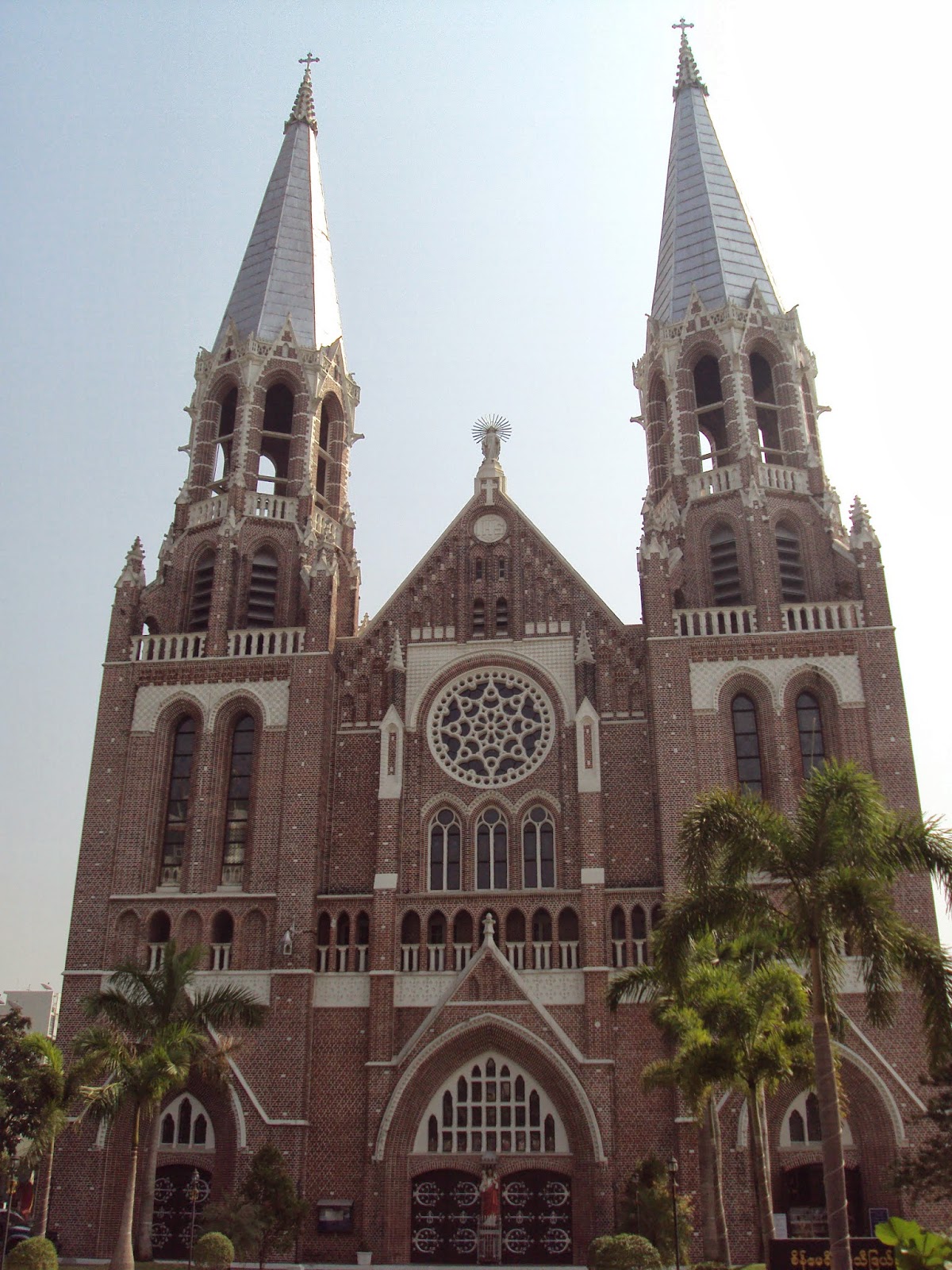
St Mary's Cathedral, Rangoon
Shocked and awed I was. And disappointed I became when the gate was closed and wouldn’t budge. There I was, the crux of my travels, of my venture to seek out the ecclesiastical heritage of Southeast Asia, and I was stopped by a gate that would not budge.

I said out a small prayer, requesting, if only, to visit this monument built to the glory of God. Just as I thought all hope was lost, out of the blue, someone appeared from within the church and opened the gate. There he was, a simple parishioner, but to me, he was literally the answer to my prayer. Providence works in mysterious ways.
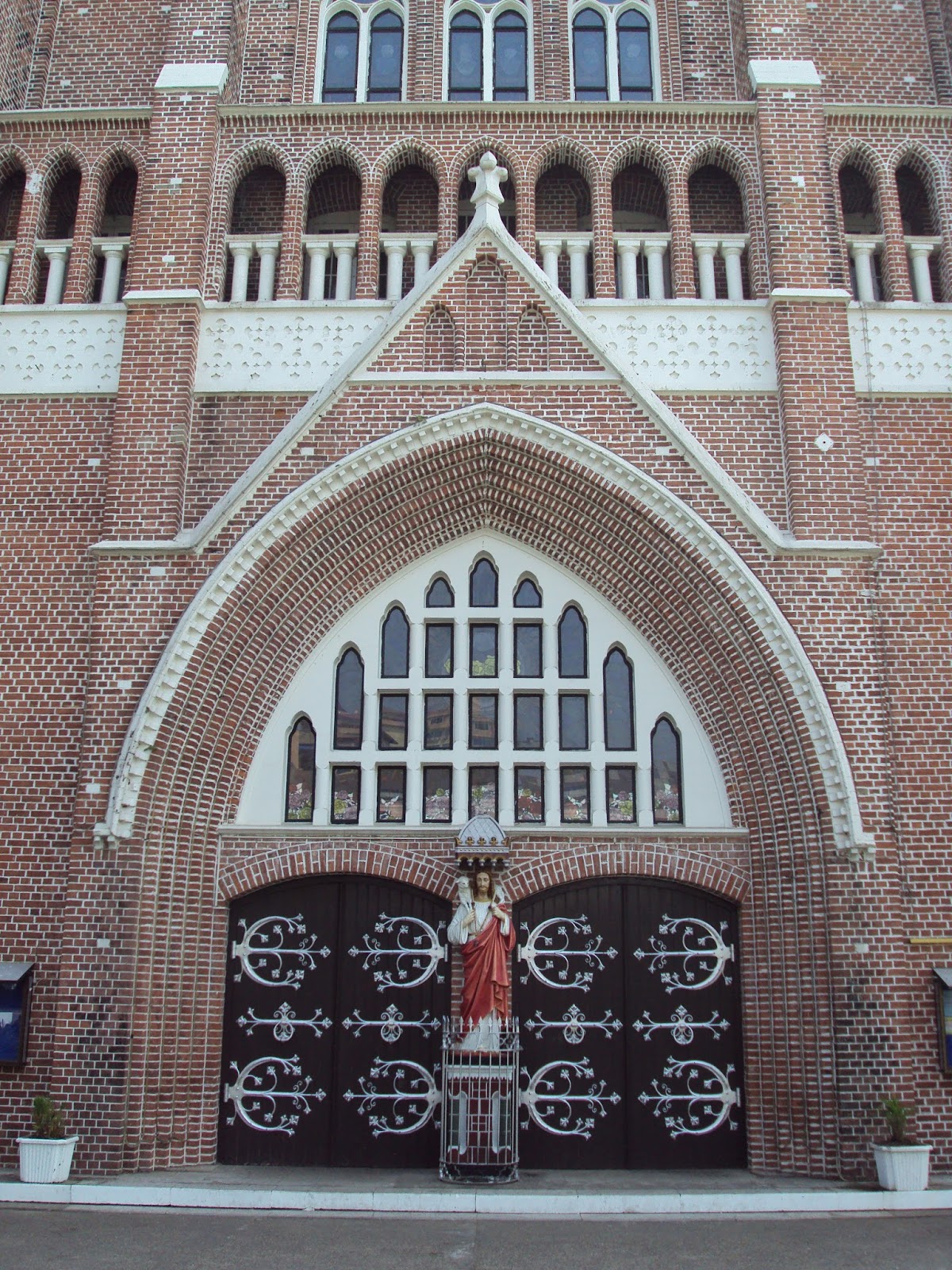
Great Door, St Mary's Cathedral, Rangoon
If the architecture outside did not awe, then the interior would surely put you to heel. From the outside, the sheer detail and scale kept with French Gothic lines; grand yet not imposing. The interior though, caused you to soar.

Facing apse, St Mary's Cathedral, Rangoon
Unlike other cathedrals of this order, there was no dark stone. Here was a riot of colour, with the red and white motif seen almost everywhere else in Rangoon present and prominent here. The vaulted ceiling highlighted by the interplay of dark against light, the stained glass windows adding further dimensions and the numerous stations of the cross and relief of the lives of the saints were not only carved in marble, they were coloured.
Stained Glass, St Mary's Cathedral, Rangoon
Niches were filled with statuary, complementing the lower panel with the carved ‘scenes’ and stained glass window in between. This was not a drab, somber church building: this was a celebration of colour, architecture and art.
Niches, St Mary's Cathedral, Rangoon
This was and is a fitting end to my journey, both of my first exploration of Burma and Rangoon, but also a fitting end to my personal project, a quest to seek out the great church buildings of the colonial age.

But there was one thing I somehow had to do. I had to see The Lady.

So, on my last day, heading to the airport, I asked my driver if we could pass her house. He was more than happy to oblige. Revealing his hopes and dreams shared with The Lady, we arrived at her house along University Avenue, along the shores of Inya Lake.

Next door, the American Embassy grounds were massive, apparently the largest in Southeast Asia. Daw Aung San Suu Kyi’s house was surrounded by a high brick wall with barbed wire, but unguarded except for a guard house by the main gate.
Party Banner, Aung San Suu Kyi's House
Sadly, I could not have afternoon tea with her: she spends weekdays in Naypyitaw and weekends in Yangon. Just as I was taking pictures and soaking in the atmosphere amidst rush hour traffic along a major road, another taxi with a middle aged couple stopped, and they also took pictures.
Main Gate, Aung San Suu Kyi's House
We acknowledged one another and expressed disappointment that The Lady was not around. Then as we took pictures, the guy commented, and I wholeheartedly agree: “We just have to do it!”

Saturday, March 15, 2014

Myanmar - Yangon - Day 3 Part 1

After the heady grandeur and forlorn glory of the Pagan Plains, I somehow savored the return back to Yangon. The dust tracks and dry surrounds gave way to uncertain driving systems within a city grid that somehow made sense. I sought to explore again.

So early in the morning, I decided to take a stroll around the city, making a loop along the grid and seeing what edifices the British left in this their great commercial centre, which apparently at its peak, rivaled London in civil services and utilities.
Former Rangoon Railway Building
Boxing the grid is the famed circular railway of Rangoon, which formed the boundary of the city core, and right next to the Trader’s Hotel is the former Railway Office, a beautiful red brick building in an otherwise unkept compound.
Restoration of Rangoon Railway Building, future Peninsula Yangon
I was informed by SSM that this building is meant to be turned in to the Peninsula Hotel Yangon, and indeed, a lot of work was being done, but still much more was needed, especially with the grounds. Even in its current state, one can already see the grandeur, and it does not take much to imagine it in its reincarnation as a luxury hotel.

Truth be told, one of my main aims in this is to finish my private project: a compendium of ecclesiastical structures in Southeast Asia. Rangoon, in its glory, somehow eluded me, until curiosity beckoned me in like a maneki neko. I have never seen Burma as a major centre of colonial power until this trip.
Scott Market, a.k.a. Bogyoke Market, Rangoon
Surely, ‘Lord Mountbattern of Burma,’ a title in itself should have hinted at its importance, yet it still did not register, and that was a thought that ran through my head as I walked westwards away from the old Railway Offices towards Scott Market, until a spire jutted out from amidst the relatively flat city scape.
Cathedral of the Holy Trinity, Rangoon
Then there before me: the Anglican Cathedral of the Holy Trinity. I did not know what to expect, but I was sufficiently blown away. The commercial and administrative centres of Hong Kong, Singapore and Kuala Lumpur may hold sway over our (or at least my) idea of British colonial splendor but little is known about Rangoon. This was like finding a clear cut diamond amongst the ecclesiastical sapphires of the Anglican Communion in East Asia.
Buttresses, Holy Trinity Cathedral, Rangoon
Rose Window exterior, Holy Trinity Cathedral, Rangoon
The red brick juxtaposed against the leafy surrounds and well-manicured lawns, the soaring white English-gothic spire balanced against the sturdy buttresses of the French-gothic support structures, the beautiful rose window against the pointed windows and gabled roofs; all within a small compound of quaint provincial life, amidst a family of ducks waddling in the green as the deacon takes a nap on a hammock underneath a tree.
Pastoral scene, Holy Trinity Cathedral, Rangoon
If the exterior was this grand, I started to imagine what the interior was like. Entering from a side door by the ambulatory, I saw a small welcome sign, and passed the small, unassuming door. I was not prepared for what surprises lay within.
Rose Window, Holy Trinity Cathedral
Apse, Holy Trinity Cathedral
Inside, despite the construction and restoration work, was a mass of space, a riotous play of light and dark punctured by the brilliant colours of the stained glass windows by the apse. Bamboo scaffolding unable to hide the majesty of the sanctuary, painting and restoration work notwithstanding, it was still a sight to behold. The beautiful rose window playing colours against the austere white of the walls, the interplay of architecture with stagecraft is almost unparalleled in the region, even when compared to other more high profile British commercial centres in the region.
Side chapel plaques, Holy Trinity Cathedral
Memorial plaques, Holy Trinity Cathedral
Within, small chapels had dedications to the fallen, as in other Anglican churches in the colonies and protectorates. The colours, standards and insignias of different regiments from different times, all form a testament and memorials to all for all.
Scaffolding statement, corner Bo Gyoke & Shwedagon Pagoda Rds
Merchant Rd, Rangoon
With my appetite whetted with this small gem, I decided to plough through the day, deciding to delay my breakfast plans until I have at least seen as much as I could of Colonial Rangoon and her edifices. Amidst the history, sections of the city were being upended and transformed, scaffolding advertise different developers doing different projects constructed by an almost multinational yet distinctively Asian face.
Old against new, Merchant Rd, Rangoon
Yet the grand colonnades and various Greek-order columns stand firm in Rangoon, despite modern Yangon trying to stamp in her authority. Some forlorn and abandoned, with dust, grime and ‘occupation’ a world away from their origins, next to gleaming yet faceless glass and steel erections that so characterize ‘development’ in Asia.
Merchant Rd, Rangoon
Buildings from all ages and times stand side by side in Rangoon and Yangon; the great British structures with their imperial defiance next to playful turn of the century Art Deco blocks, punctured by 60s Internationalism.
Corner, near Sule Pagoda and Merchant Rds, Rangoon
Yet some structures still remind you that this was a British colony close to the heart of the British Raj. Not quite part of the British Raj yet not quite part of British Southeast Asia; Rangoon shares an eclectic mix of Georgian- and Paladian-colonnades that typifies colonial Singapore and Hong Kong yet with the Moorish tendencies that highlight Kuala Lumpur and Calcutta.
High Court Building, Maha Bandoola Park St, Rangoon
The High Court Building, fronting the Maha Bandoola Garden would not look out of place in any station of the British Empire. It looks like it could belong in Melbourne, New Delhi or London itself, with its grand and almost imperious gaze down in the city. The grand clock tower in itself forms a perfect centerpiece in this monumental centre, with smaller yet equally impressive buildings paying homage, from the frosted cake of the Yangon City Hall building to a delightful building with a tower in the corner just next door.
Yangon City Hall, Maha Bandoola Garden
Northeast Corner, Maha Bandoola Garden
The more I walk, the more I became excited, wondering what other surprises lay just around the corner. The good thing about the old colonial heart of Rangoon, against the sheer mass of Yangon, is the ease of navigation within the city grid, with easily navigable city blocks.
Rander House, Pansodan St, Rangoon
With surprises at Rander House and Corinthian columns in front of it, Rangoon felt like the culmination of years of travel in disparate yet connected colonial centres in Southeast Asia, with bits of Georgetown, Victoria, Singapore and Kuching all contained within.
Corinthian columns, Pansodan St
At this rate, my breakfast plans at The Strand would have to wait a bit longer than expected. I am, after all, easily distracted when something catches my eye and my feet urge on my curiosity.

Wednesday, February 19, 2014

Myanmar - Bagan - Day 2 Part 3

After a nice sandwich, a few big bottles of water and lounging by the pool at the Tharaba Gate Hotel, I decided to continue on my little exploration around Bagan, just after lunch, under the scorching sun of the Burmese Dry Zone.
Tharaba Gate, Old Bagan
I started at Tharaba Gate itself, or what’s left of it. At its height, Bagan had an inner and outer core of a city, and the important districts lay within the walls, with the palace complex itself just behind the city gate.

The gate itself is a shadow of its former glory, having been destroyed by the Mongols, but some remnants of the main defensive walls that encircles the city and reach to the Irrawaddy River stand, though the moat is silted up, with some sections reaching as high as 5 meters. The gate can just squeeze in a modest-sized minivan.
Just within the walled city is a temple built as a replica of the one in Bodhgaya, India: the Mahabodhi Temple, built in 1215. It has striking similarities to a temple tower within the Shwedagon Pagoda complex, though arguably this was built first.
One of many 'Stations of the Buddha'
This temple contains dedicated walkways that document Gautama Buddha’s life, from a special pavement where pilgrims can pace up and down on cool marble slabs to imitate Buddha’s pacing up and down in a beautiful garden, to a small complex with a pool, which seems to have run out of water.
The Bupaya, Old Bagan
A short drive away, amidst lacquerware schools, by the river is the Bupaya, the first stupa built in Bagan. The stupa, though not as impressive as later constructions, has a setting that creates a certain impact. On the banks of the Irrawaddy River, on a small bluff, rises a big bell-shaped chunk of gold.
Makeshift quay, Bupaya, Old Bagan
Just outside, down the stairs that lead to the riverbank, is what I presume is a main quay, with boats moored on the shore, some taking tourists on a sightseeing cruise along the river or to ferry people up and down the shores. The river is quite majestic, with a small island in the bend.

Around the corner, with towering pagodas beckoning me in, the driver stopped by another great pagoda, the Gandawpalin Pagoda, this time shimmering white, looking as if the plaster was laid not too long ago, with the main stupa’s spire gilded top shining under the hot midday sun.
Gandawpalin Temple, Old Bagan
It was here where I encountered a rather interesting business model. It could have been a happy coincidence or a well-executed plan, but as I was taking pictures from the gate while walking up, a girl, looking as if she was fresh out of school, popped out of nowhere and seemed genuinely surprised and apologetic that she almost got in to my picture. She then told me of a few good spots for photos. My scam radar was pinging like no tomorrow.
'View 1' recommended, Gandawpalin Temple
This girl told me she was not a scam artist, and that she works with the temple. Fair enough, it is a free market and she did not look like your average peddler with trinkets having off her body. Yet, something didn’t feel quite right as we walked around the temple as I took pictures.

I was just waiting for her to ask something. Donation? Offers of discrete dealings? A diplomatic pass? (The latter is not too far off the mark: my face seems to say ‘UN’ or ‘diplomat’ in some countries.) It was none of the above. She asked if I wanted to buy her book.
'View 2' recommended, Gandawpalin Temple
Now that was very new. She had other things to sell but she went straight for book. After complementing her on her business acumen and language skills, I went down for a bargain. I asked for KYT 5,000 from her offer of KYT 10,000 for her copy of ‘Folk Tales of Burma’, which she agreed to, on the condition that I buy a set of postcards. I was hesitant on the postcards, until she pulled the ‘you will help my brother go to school’ card.

I decided to buy both, and she assured me her postcards are top quality and will not be easily found anywhere else in Bagan (which was true: had a hard time finding it in the other major temples). I had my own condition: explain to me how it all worked.

She told me every temple has a cooperative, which fits with her ‘work with the temple’ cover. She also told me they buy their goods from a supplier in New Bagan, and every peddler has their own niche. Some do lacquer, aiming at middle-aged European tourists, some aim book towards travellers like me, all have their market and no one intrudes.

Wishing her a good day, I complemented her on her very good grasp of English. She was a bit shy from the complement, saying the travellers she met at the temples and in Bagan taught her. I can see why she chose the extroverted complimentary guide niche in the temple.
New finishing over older wooden carvings, Thatbinyu Temple
Within the stairwell, Thatbinyu Temple looking towards Gandawpalin
From there I went to another temple across the road, the Thatbinyu Temple, and before I could react, I was ‘guided’ by a guide who did not want money (A first?). She did not have the finesse of the girl in the previous temple, but she did lead me up passageways where I could get to the terrace, view the ‘skyline’ of Bagan and explained to me the wooden panels and murals.
View, upper terrace, Gandawpalin Temple
Gandawpalin Temple, Old Bagan
In return: she wanted me to buy lacquerware. I told her I have a budget, and interestingly enough, she seemed to enjoy pushing a business card case which cost less than the set of coasters I got. Told her I had more utility with the coasters than a business card case. For KYT 10,000 from the original KYT 20,000 for a set of 8 coasters with fine carvings, I was happy.
Interior bracing, Nanpaya Temple
Brahma carving, Nanpaya Temple
Next up was a lone Hindu temple, the Nanpaya Temple, amidst a sea of Buddhist temples. While the exterior is well preserved, the interior suffered structural damage from the 1975 earthquake and had to be supported by internal braces. Inside the dark cavernous hall, the beautiful murals were best seen with a flashlight, and the carvings in the central sacred space are well preserved.
There were a few other, equally impressive temples and ‘libraries’ with even more beautifully preserved murals, which sadly I cannot remember the names of for the life of me, but are still best viewed with a flashlight. The authorities seem to have either switched them all off or made it so dim, it doesn’t seem to make much difference. There were a few clusters, within close proximity to the lacquerware factories and such, and within a village, it gave a sense of what life would have been like in the day.
Interestingly, only temples built by kings, or major stupas have names. The other stupas and temples are numbered. According to my driver and multiple books on the subject, the numerous temples and stupas were built by anyone who had means. The kings, since they had the most resources, built the most lavish ones, while merchants and senior officials built their own, both for merit and paying for their upkeep and a resident clergy. The great masses of unnamed temples have a number assigned to them, catalogued by Pierre Pichard, a French architect in 1996.
Mingalazedi Stupa
Next up was the Mingalazedi Stupa, this time ungilded and in its raw red Burmese brick form. Up from the terrace, you can see the wide expanse of the Bagan Plains, this time from within the walled city, which gives a majestic dense view.
First terrace view, Mingalazedi Stupa
Here, walking along the first terrace, glazed terracotta plaques narrate the jatakas, old Buddhist stories narrating the life of Buddha and other Buddhist tales and fables. Sadly, the top two terraces were not open, as the view would have been breathtaking.

'Prime Minister's Temple'
Dhammayangi Temple, Bagan
Interior, Dhammayangi Temple
After a quick stop at another temple, the ‘Prime Minister’s Temple’ as my driver put it, we went the Dhammayangi Temple. This is the largest temple in Bagan, and because of its sheer bulk and amount of materials used in its construction, from certain angles and from a distance, it looks pretty much like an Egyptian step pyramid. Within, the corridors snake around a central sacred space, with some corridors and arches partially filled in, which only lends to legends and myth about this building.
Sulamani Temple, Bagan, note similarities to Ananda Temple
Shwesandaw Temple
Then, a short drive away, we went to the Sulamani Temple, before heading to the main sunset temple, the Shwesandaw Temple. I was informed that during the peak season, it would be hard to get a spot. Not what I experienced. As sunset was around 1730 onwards, we went there early, around 1630 for me to walk around and get a nice spot on the top terrace.
Steps along Shwesandaw Temple
It was, to put it lightly, a bit of an ascent up, somewhat steeper than the first stupa I scaled up, but with views that define Bagan. The first two terraces already had impressive views, but from the top terrace, some people were already setting camp, complete with tripods and multiple lenses. The closer it got to sunset, the more people came, but everyone had a good spot to view it.
Gandawpalin Temple on left, Ananda Temple on right
Dhammayangi Temple on left, hills in the backdrop
Up here, I could see the Bagan Plains all the way to the hills and mountains that trap in the heat. The multiple spires, temples and stupas jot out from the landscape, just begging you to imagine what it was like at its height. While Angkor has the wide landscape with a large centerpiece, Bagan has the density and feel of metropolitan majesty.

Mingalazedi and Irrawaddy River in background
Most importantly, there were no massive tour groups blocking you, the only mild annoyance was the loud but thankfully small group of Mainland Chinese tourists who went up then quickly went down. That pretty much summed up Bagan for me.