Thursday, April 11, 2013

Manila - Civitas Sacra

Consider the following statement:

“The icon seeming to lurch towards onlookers, who were then considered blessed by the Virgin. Clergy touched pieces of cotton-wool to the icon and handed them out to the crowd […] a great crowd watched [sic] such a display, whilst a street-market for unconcerned locals continues in the foreground.”

Such was the observation of Pedro Tafur, a Spanish writer and traveller, who went around and explored the Mediterranean in the 1430s. And that indeed was the image I saw by the Basilica of the Black Nazarene in Quiapo Church.

But let us not get ahead of ourselves. Our story today started of innocently after breakfast. I checked in at the Mandarin Oriental, had a nice breakfast, and studied my map, planning my day.

I took a taxi headed straight to St Sebastian’s Basilica in the old part of Manila, north of the Pasig River and northeast of the Intramuros. I had a nice chat with the friendly taxi driver, and we talked about, oddly enough, high profile legal cases when I told him of my legal background.

Granted, it was Christmas Day, so I was somewhat expecting a large celebration. Alas, my taxi driver told me that Christmas Eve is the more important. He also cautioned me about the area where the Basilica is located. It is a predominantly Muslim area, and recently there have been violence between Muslims and Christians in the area.
Basilica of St Sebastian
The drive there was very smooth, contrary to the image of Manila being a convoluted, traffic-choked city, and it took me 20 minutes. It cost me just under US$ 4 to get there from Makati City, and for being such a nice guy, I offered my taxi driver a little extra. Granted, it wasn’t much, but to him, he felt glad and was truly grateful when I told him to keep the change.
Administrative Building, Basilica of St Sebastian
He stopped at the steps of the church and made the sign of the cross in reverence towards the church. Seeing his honesty and devotion was truly touching. Having wished him and his family well, and a blessed Christmas, I entered the basilica.
Interior, Basilica of St Sebastian, towards liturgical east
Stained glass, Basilica of St Sebastian, prefab in Germany
High Altar, Basilica of St Sebastian
It was there I the culture of the Philippines was laid bare, at least religiously. While most would be in their best when attending church with reverence amidst the ceremonials, there it felt like a ritual, a thing to do. Some easily strolled in and out during rituals, children were allowed to play around, some went through the motions, most were in ordinary street clothes, while some looked nonchalant.

Christ effigy, Basilica of St Sebastian
Tromp l'oeil, by High Altar
But the cultural aspects aside, the church was truly beautiful. As a friend in Holland remarked, the interior would not look out of place in the Low Countries. Unsurprisingly, the church was made, an all-steel church, pre-fabricated, in Belgium, in its entirety.
Tromp l'oeil, ceiling, Basilica of St Sebastian
Within, beautiful stained glass, tromp l’oeil artwork and effigies used for processions abound. When mass ended, I strolled through the building and structure, observing without being intrusive. A few nuns nodded in welcome, as I savoured in the beauty.
Furry friend on Paseo Hidalgo, Quiapo
Walking away from the church, I went down Hidalgo Street to the great plaza of the Quiapo Church, the Basilica of the Black Nazarene. This truly is a crossroads of cultures. If this was a mere shadow of its past, I could not begin to imagine what it was like when Manila was the jewel of the Galleon Trades.

Crossing over from the underpass, it was sheer chaos, a madness one would associate with a mad market. The grand Plaza Miranda was laid out in front of the basilica, with somewhat garish paint throughout. Markets and stalls surrounded the plaza, as throngs of people went in and out. Church service was on the hour, apparently.
Quiapo Church and part of the markets
From the colonnades and statues of the saints looking down on the plaza, I tried to enter the church. When I went in, an opening formed, amidst the crowd, so I strolled in, wondering why such an opening was present. People were lining in formation, and I squeezed in. And then I discovered why: mass has ended and the priests were out to bless the people.

And it was then did Pedro Tafur’s words ran through my head. As the priests were out sanctifying the people with their holy water aspergillum, everyone rushed forward, eager to get a drop. Some held out clothes and handkerchiefs, others bibles and icons. I couldn’t move; I felt as if I was in the way of the throng, and the priest just decided to sprinkle my entire shirt with a healthy dollop of holy water, along with dangling pieces of handkerchiefs and rosaries.

Eager to get a glimpse of the Icon of the Black Nazarene, I went further in the basilica, a large cavernous hall. People were everywhere, the mass felt orchestrated and without the reverence or ceremony of a mass I am used to. Yet the sheer size of the hall, and the number of people streaming in and out and remaining inside did not fail to impress. All for the reverence of a wooden statue of Christ, which survived a sea journey and fire from Mexico.
Interior, Basilica of the Black Nazarene, Quiapo Church
Outside, Pedro Tafur’s words again came to mind, as people once again were clamouring to get divine favour from drops of holy water and the image of an icon, following clergy who were out blessing, even to the extent of a priest who was trying to get every drop out of his aspersorium with his aspergillum, literally.
Blessings outside, mass inside
Surrounding the basilica, Plaza Miranda was indeed a mad sight. Makeshift stalls and shops abound, amidst the statuary of saints and images of the cardinals of the church looking down from their lofty heights. Icons and statues of the Santa Nino, the Christ Child were everywhere. Amulets for blessings and potions for maladies, makeshift pharmacies and stalls selling things that befuddle the mind.
Quiapo Church, from Quiapo Plaza
Not quite Byzantine Constantinople but still the feeling of a city immersed in the divine; a culture where Papal dogma and traditional belief blend so well together to create a unique hybrid; where traditional superstition combined with Catholic teaching made a handkerchief with drops of holy water a sacred object, where mere images of icons and statuary would protect against all maladies.

Manila - Loyal & Beloved


I never had a desire to go to Manila. None whatsoever. Though admittedly, curiosity did get the better of me, especially considering Manila has one of the highest concentrations of Roman Catholic churches in Asia, second after Macau, with a very rich religious tradition.

Also, during this time, I was reading about Constantinople during her heyday as the capital of Christendom. The ecstasy, the intermingling of the divine and the profane in a square mile, all fringed by a grand harbour, somehow made me think of Manila. That and the latest Bourne movie, the Bourne Legacy, was filmed there, so I was a bit curious to see how movies and reality intersect.

(*my Macau trip was likewise influenced by watching the latest Bond movie, Skyfall, despite the fact the movie crew hardly stepped foot in Macau.)

Manila, the capital of the Philippines, is a monster of a city. Just the thought of it is enough to scare you with her sheer size. Yet, despite that, the airport leaves little to be desired. I took a last minute flight to Manila, on Christmas Eve itself, after celebrating Christmas Eve Mass in Kuala Lumpur. Timed just right, I was due to arrive in Manila at ‘absurd o’clock,’ when, hopefully, I can check-in at the hotel early and have a whole day exploring the city.

Now, the airport was a sheer nightmare. I have been to chaotic airports before. Medan Polonia is a throwback to the 70s, Jakarta Soekarno-Hatta has terminals right but departures facilities a bit wrong, especially with lounges, and Denpasar-Bali before the renovations is sheer madness. I landed at Manila International’s new Terminal 3, and the layout felt very dated, despite being operational for just around 2 years.

I have nothing against ‘different’ layouts or basic facilities. I do, however, have a bit of an issue with poorly designed arrival facilities, especially immigration. In most airports with international arrivals, there is a ‘resident/X nationals’ lane and an ‘others’ lane. In most major Asia-Pacific airports, there is even an ‘APEC/Diplomatic’ lane. In Manila Ninoy Aquino International Terminal 3, it was all muddled up, no separation of the masses.

The queue went on for miles, and with no separation between locals/foreigners at counters, understandably, first timers can easily get confused. With 3 flights arriving simultaneously and only maybe 6 out of 26 counters open with hundreds of passengers, it was a nightmare waiting to happen. I arrived at 4am, so I wasn’t expecting that many people.

In the end, I waited until 5.30 am to finally reach a counter, get my passport stamped and officially enter the Philippines. Contrary to their tourism marketing promo, everything is not more fun in the Philippines, especially waiting for more than an hour to pass immigration.

Yet after the airport hiccup, I was pleasantly surprised with Manila. It took a few minutes to adjust to the fact that they drive on the right side of the road, but otherwise, to get from Manila Ninoy Acquino International Airport to the Mandarin Oriental Manila in Makati City, it took me all of 20 minutes smooth sailing at 6.15am, costing just under US$5. The perfect way to start a pre- and traffic hour taxi ride comparison.

Most loyal and beloved? It is beloved if the traffic was as smooth sailing as that on a very regular basis.

Much Delayed

Yes, it has been quite a while since my last posting. To say that I have been busy is partly true, but I could always make time. Nay, I have been lazy, and other things have somehow conspired to prevent me from writing.

Why you ask? A trail running marathon last month and a few trips and conferences amongst others, so training for it did take up much time.

But alas! Time is back on my side-ish. The much delayed reportage on Manila, and Singapore from a different perspective is up next. That, and perhaps a curious outlook on the city formerly known as Saigon: Ho Chi Minh City.

Tuesday, January 22, 2013

Hong Kong - Within Glass Canyons


One of the most interesting aspects of Hong Kong is how they manage to blend in the old and the new, the traditional and the modern, all compacted into a very, awfully tiny square mile that is almost a joy to wander around.
From right: Mandarin Oriental, HSBC Main, Bank of China Building, Cheung  Kong Centre, Bank of China Tower
Wandering around Central, you’ll see the remnants of old colonial Victoria, back when she was an outpost of Empire. Back then, she was a major trading center. More than a century later, she still is a major trading centre, and a financial centre to boot.

And it is little wonder if you walk around the city and notice the close relationship the colonial structures have in defining the city. A city built with trading at its heart, with order maintained, with a rule of law, and with the goodwill of Providence guiding the way.
Former Supreme Court, now Legislative Council Building
Thetis, goddess of Justice
Corridors fronting Statue Square
The Legislative Council Building, the former Supreme Court of Hong Kong is a beautiful structure, in the heart of Central. Symbolic, perhaps, an indication that yes, order and the rule of law reigns supreme. The structure is beautiful, with an almost London-feel to it. The corridors still exude the grandeur of the place, the attention to detail a nod to the time, effort and expense paid in keeping such a structure, and Themis, the goddess of justice look out from her perch on to Statue Square.
Cenotapth, Hong Kong
Across the square is the Cenotaph, a monument to the Glorious Dead, and an homage to the Cenotaph found in Whitehall. Just as I was there, there was a memorial service, and I noticed the solemn procession and reverence the visitors paid to those who have sacrificed so that we may enjoy the benefits of the now.

Across the square is the HSBC Main Building, and within the public plaza of the HSBC Main Building are two bronze lions: Stephen and Stitt. Stephen sits on the left, half roaring. Stitt on the other hand, looks as if he wants you to pet him. Both have battle scars as a result of the Japanese attack on Hong Kong in WWII.
Stephen roaring
Stephen's shrapnel wounds
Stitt: wants pettings
Stitt's minor shrapnel wounds
Just around the corner is the Bank of China Building, not to be confused with the Bank of China Tower across the street. Likewise, it has a pair of lions: two traditional Chinese-style lions and another curious stylised lions.

Traditional Chinese lions
Not-so-traditional Chinese lions
Just behind the HSBC Main Building is the former French Mission, now the Final Court of Appeal, a beautiful red-bricked building sitting on top of a hill, reached via a beautiful staircase. Across the green, hidden amidst the greenery and lush trees of Central is St John’s Cathedral, the seat of the Anglican Diocese of Hong Kong.

Former French Mission, current Final Court of Appeal
Stairway to St John's Cathedral green
St John’s Cathedral Hong Kong is typical of your British-built churches in Southeast Asia, reminiscent of St Andrew’s in Singapore and Christ Church in Bangkok. She shares the same vaulted ceilings as in St Mary’s Kuala Lumpur and beautiful side chapels.
St John's Cathedral, Hong Kong
Like St Mary’s Kuala Lumpur and St Andrew’s in Singapore, she is a monument to the British Administration, with plaques commemorating the illustrious and the departed, and the visits of Queen Elizabeth.
Viewing liturgical East
Viewing liturgical West
One of many memorials
Towers of Providence and Wealth
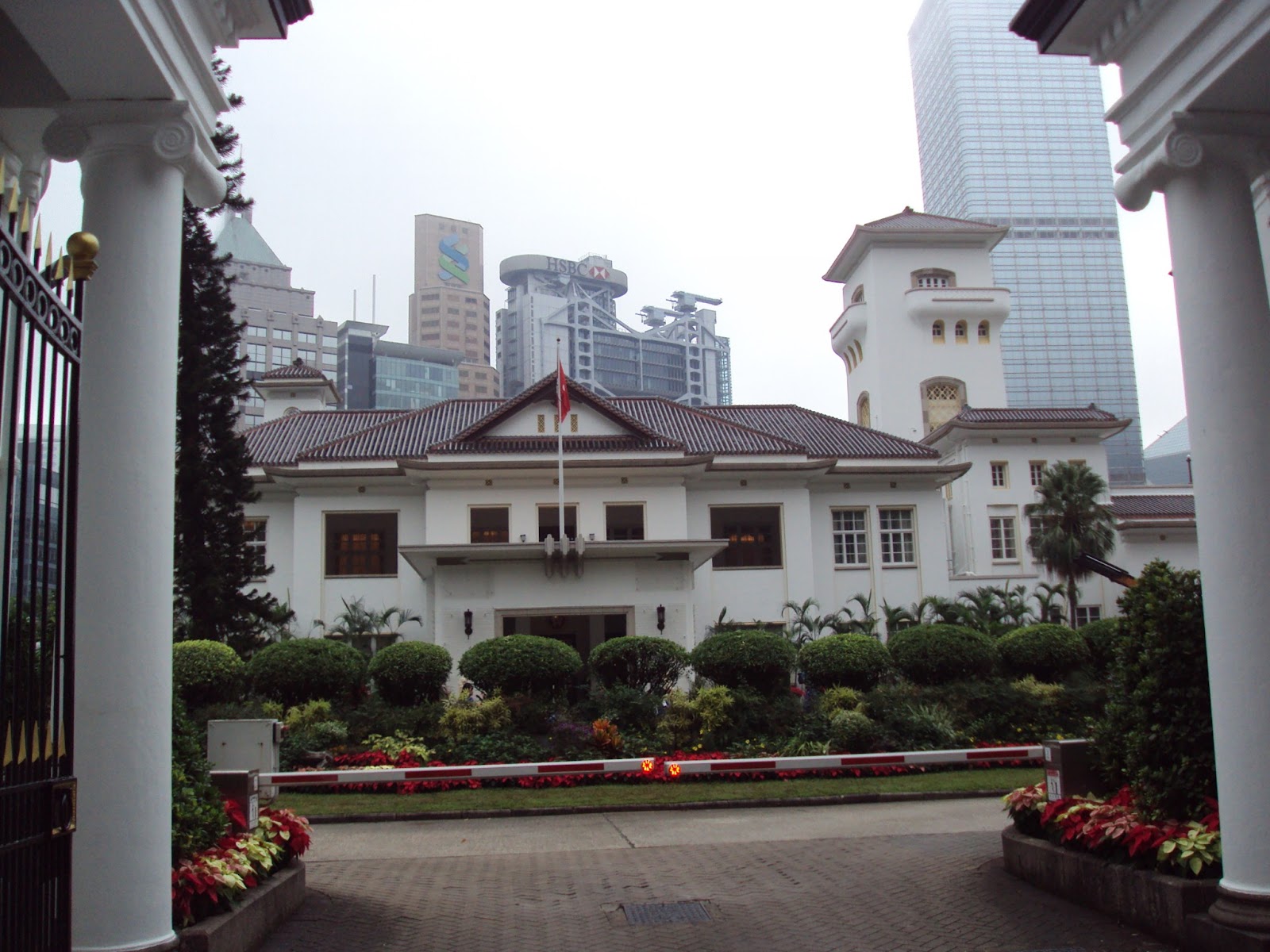
Further up the hill is the Government House, the former residence of the British Governors of Hong Kong, and now the residence of the Chief Executive of Hong Kong SAR. Sadly, the grounds were closed, but that didn’t quite stop me from sneaking in, ala Samwise and my sneaking in to the Red House, the residence of the Chief Executive of Macau SAR.
Government House, Hong Kong, Government Hill
Just around the corner, beyond the Botanical Gardens, in a rather secluded area with a hidden passageway is the Roman Catholic Archdiocese Compound and the Cathedral of the Immaculate Conception. Compared to St John’s, the Immaculate Conception is rather plain, with simple buttresses outside, and even simpler interiors.
Cathedral of the Immaculate Conception, Hong Kong
Though not as richly ornamented with memorials and plaques, the Cathedral of the Immaculate Conception is airy and wide, with the statues of saints looking sagely down, reminding the congregation of their duties while looking down with compassion.
High Altar, Cathedral of the Immaculate Conception
Viewing liturgical West & grand organ
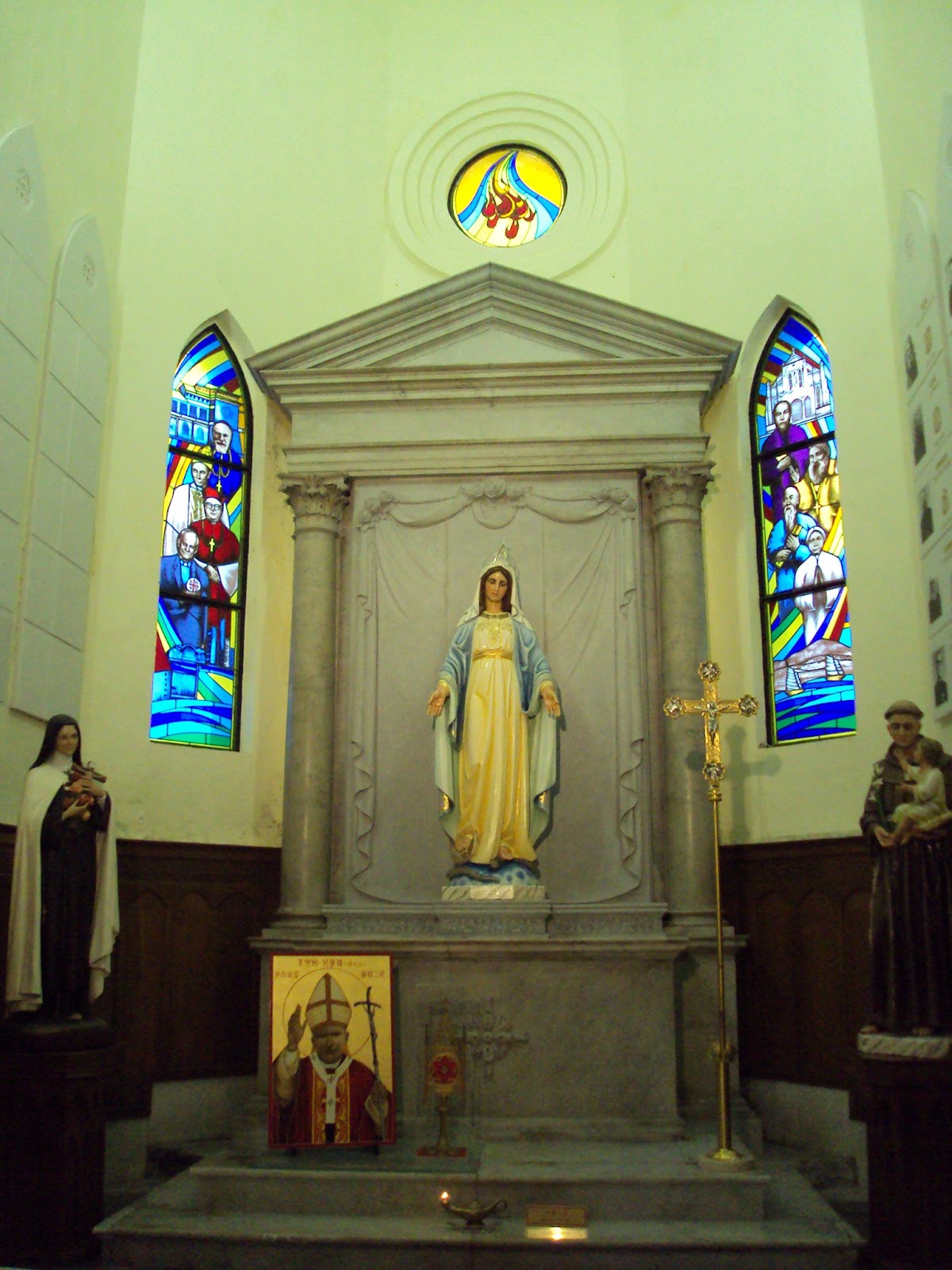
Lady Chapel & Relic of the Blessed John Paul II
Within the side chapels, at the lady chapel at the back though is a little surprise: a relic of the Blessed Pope John Paul II, contained in a beautiful reliquary, with a Byzantine-style icon next to it.
View from Hong Kong Botanical Gardens
Hong Kong never ceases to surprise. Look within the glass canyons, and relics of the past, quite literally, lies within. 

Tuesday, January 8, 2013

38 floor

A productive and good new year ahead to all my readers. This post comes from the 38th floor, overlooking the Petronas Towers and KLCC in dear old Kuala Lumpur. With a pot of early Grey, I wish you all well.

Upcoming posts will include more colonial treasures of Hong Kong, exploring Macau's Roman Catholic traditions and a sudden expedition to Manila.

My coming book is shaping up well, and my sudden but exciting last minute trip to Manila for research will be quite the tell to tale, once I get it all planned out.

Site back, relax and enjoy the world and what it offers. Don't waste away on frivolous things or second guess; life with few regrets is best compared to constantly going 'what if?'


Thursday, December 27, 2012

Hong Kong - a different view

2ifc, with Hong Kong Station

Hong Kong is one of my favourite cities. It is dynamic, easy to navigate and there’s always a surprise just around the corner. That, and the harbour. Enough said.

The easiest way to get in to the city is via the MTR Airport Express, with the station right after arrivals. The Airport Express Travel Pass at HK$100 is a good way to get around town. It gets you a return ride on the Airport Express and unlimited trips on the MTR network for 3 days. Plus, it acts like the normal Octopus Card, reloadable and all so you can use it on the Star Ferry and tram networks, apart from paying for groceries.
So, this time around, I decided to stay an extra day to really explore Hong Kong. I have never really done the tourist bits in Hong Kong, bar the Peak so this would be different.

Of course, no trip to Hong Kong would be complete without a ride on the Star Ferry. There really isn’t much of a fare difference between the upper and lower deck on the ferry, and the terminal is connected to the ifc complex on Island Side, and across the street from Nathan Road and the Brutalist Hong Kong Cultural Centre in Tsim Sha Tsui in Kowloon Side.
The 'new' Central Pier
Along the Promenade on Tsim Sha Tsui (or TST to those who can’t quite pronounce Djim Saa Choi or however it’s rendered correctly), every morning at around 8-ish, you will see both tourists and locals doing some exercise: locals doing their fan-based tai chi and tourists trying out their hand with an old master tutoring them.
'Political Statements'
Kowloon skyline
The view from TST is sheer amazing, and even with the dense fog during my stay, it is still a panorama to soak in and enjoy. Interesting architecture and cultural sights along the way, the Promenade also functions as Hong Kong’s Avenue of the Stars, an homage to the city’s film industry.
Dense fog over Hong Kong Island
Amateurs in background left, professionals with fans in foreground
Part of the Avenue of Stars
Around TST, little bits of old Hong Kong abound. There is the iconic Peninsula Hotel, a very nice spot to while the day away over a cup of tea and scones, or just down the road along Salisbury Rd is the Heritage 1881, a beautifully restored colonial Former Marine Police Headquarters, now a shopping mall/restaurant complex. While it does look a little over-done in some places, the old structure still looks on proudly despite her questionable facelift.
Peninsula Hong Kong, Salisbury Rd
Heritage 1881, Salisbury Rd
Main building and stables to left, Heritage 1881
Artillery gun relic, Heritage 1881
'Down the barrel of a gun'
'Response' to 'Political Statements'
Back on Hong Kong Island, an architectural gem lies in the west past Sheung Wan and at the border with Kennedy Town. Getting out from Sheung Wan MTR station, old Hong Kong is before you. The quaint trams wind their way through narrow streets as the Western Market makes you wonder if you are in Melbourne. The damp cloudy grey weather does not help erode the questionings.

Western Market, Sheung Wan
Sheung Wan side streets
Sheung Wan
Hong Kong University, a secular educational institution set up by the merchants, traders and gliteratti of Hong Kong, is a beautiful building, tucked away in a leafy area of the city. Surrounding it are quaint residential buildings and Hong Kong’s King’s College, a high school with a very beautiful frontage.
King's College, Sheung Wan
Hong Kong University’s Main Building is a wonderful structure, and wandering around the cloisters and porticoes provides a nice respite from the somewhat congested feel of the city. For one of the densest cities in the world, this part of the island feels very spacious.
Courtyard, Hong Kong University
Main Building, Hong Kong University
Back in Central, I went to pay a visit to my friend’s office in the International Finance Centre. Little did I know, 2ifc has a little surprise for visitors, if you dig. In a separate lobby, facing the linkway to the Central Piers is the entrance to the Hong Kong Monetary Authority, the effective Central Bank of Hong Kong, and among the few (if not the only) authority to contract out the printing of currencies to non-government linked banks.
Central, from Hong Kong Monetary Authority Plaza
The Hong Kong Monetary Authority is located on the 55th floor of 2ifc. Ask to visit the visitor’s centre, bring your passport and you’ll be whisked away for a lofty view of the city. There is a decent exhibition on Hong Kong’s currency and how fiscal policies works, but it is the view that stands out, quite literally.
Jardine House view from 55th floor, 2ifc
Sadly, there was a very heavy fog when I was there, so I could not see much. The view was not much different from my friend’s office a few floors down. Of course, my friend had only one thing to comment when we saw nothing but white:

“We have our head in the clouds, up in our lofty towers.” Quite literally, head in the clouds.